
God Rest Ye Merry Gentlemen & Gentlewomen
We’re winding down another year here at OrgCode. Heck, we’re even going to shut the door and turn off the phones for a week between Christmas and the New Year and that will be a first since we re-booted the company in Q4 2009.
God rest us merry gentlemen and gentlewomen.
It’s hard to believe that it has been two years since John Whitesell and I shook hands to grab the reins of OrgCode together – and a real honor for me given John had been leading the company as Managing Director for over 25 years.
Taking a retrospective gander at 2011 there are some things that stand out for me as great opportunities as well as lessons learned. They are:
Our professional integrity remains intact. We truly want to be catalysts for better outcomes and when we were challenged in a “bait and switch” RFP to be the mouthpiece for somebody else’s agenda after we won the project, we noisily declined to continue and ended the engagement. If you listen carefully, sleepless nights can be informative in and of themselves.
The National Alliance to End Homelessness still rocks. I just totally dig their staff and everything the organization stands for. The fact that they decided to let me start guest blogging this year is and honor and icing on the proverbial cake.
Speaking of blogs, I finally got the hang of taking point for the OrgCode blog this year. The 10 part series on the essential elements of successful housing programs was particularly well received. The one on youth and harm reduction also got some good conversations started.
Facebook page. I let attention to it slip for a while but focused attention brought with it some good results. The “Insights” button on our page tells me we are big with women. Given so much of OrgCode’s work is in human services and housing, it is no wonder that so many women look at our page due to their disproportionate representation in those sectors. Now, if only we could get to 100 “Likes”…come on guys!
Minnesota is a larger state than I thought. When I did a five-day workshop and speaking tour through the state I was amazed how long it took to get from one destination to another. Thank goodness for gracious hosts from the Minnesota Housing Finance Agency who were much more than tour guides.
Detroit would be more fun if border crossings were easier. Yes, I am working on getting my NEXUS card. I also had a habit of getting lost when in Detroit but that led to some interesting insights about the changes in the City. The work with HAND and CSH was really terrific and totally offset the tardy border crossings As an aside, there is a humorous blog I wrote after staying in a hotel in Detroit.
Another affordable housing study done. I like that we have, in a couple short years, been successful at preparing affordable housing studies in small, rural and urban communities.
Tweeting about things that matter. Slowly, I have learned the art of the 140 character haiku that is the core of the Twitterverse. Linking to interesting research, news articles and highlighting where we are and what projects we are working on has turned out to be a good use of the medium for OrgCode. Our followers have increased, and many of them are directly related to the work that we do. Now that we have the hang of it, we are looking forward to attracting many more followers in 2012.
I appreciate how much certain Executive Directors teach me. This year in particular I learned loads from Robin Miiller who is the ED of the Medicine Hat Community Housing Society about patience, seeing the big picture and graceful leadership. I learned about embracing change as an organization from Marion McGuigan who is the ED of CMHA Red Deer and in charge of the Buffalo Hotel. Susan McGee at Homeward Trust in Edmonton has shown me the value of constantly trying to improve an organization and seeking excellence day in and day out. There are other fine EDs that I have had the privilege of working with as well, but these three fine women immediately jump to mind.
Providing leadership training rocks my world. It was a real honor to roll out the leadership training curriculum, especially for folks in the trenches of non-profits who rarely get the opportunity to participate in this type of training. The few weeks I spent this year delivering this training really fuelled my soul.
Kudos are a nice feeling, but I really do like knowing what people think of my presentations, workshops, speeches, keynotes, etc. At the Ending Homelessness Summit in Michigan this year, I was the top-ranked speaker. That felt awesome. I’d still like more people to fill out our survey to give us feedback on how we can be even better in the future. We are offering a $250 donation to a charity of your choice by means of a draw from the people who complete our survey. The winner will be announced on our website and through social media on January 20.
It may be time to buy property in Alberta. The people and organizations I meet in the province keep blowing up the stereotypes that I had about Alberta. This, in turn, keeps me going back there to the point where I am spending about a third of my time in the province. I have concluded that we need to buy property in Alberta so now the “where” becomes a challenge because I have enjoyed the local nuances of every place that I have visited!
It remains an honor to stay connected to academia through York University. I love that I get to spend time with graduate students chewing on ideas related to housing, homelessness and community planning. I really dig how this helps translate into my professional work. I especially enjoy that John and I have the opportunity to take on interns and provide meaningful connections for them to the real world. Our interns have helped us to anchor some of our research work. For example, we are doing a research project with E4C in Edmonton on the experience of sexually exploited women and Housing First. Such a project would not be feasible or possible if it weren’t for the connections to York University and the involvement of my students.
Growth of a company can have false starts. I want OrgCode to grow. We have loads of work to do. But trying to find the right fit for the way that we operate, our ethics and values isn’t all that easy. The private sector and non-profit sector may seem incompatible but, in fact, they are starting to mesh and we have to plan accordingly. We had a few people cycle through this year because the challenge of our work combined with our expectations surprised them. The gem of the year has been Ali Ryder. She is a complete geek in all the right ways. She gives John and I the gears. She is an awesome analyst and I know she has a really bright future.
John is a terrific business partner and great friend. Really sappy, I know, but John is a super duper good dude. In his role as Chief Operating Officer as well as a frontline consultant, he takes care of all the stuff that I suck at, without complaining. He encouraged me to start using the President & CEO title with the full knowledge that growth and succession are realities of both life and organizations. When I look at some of the projects like Newfoundland & Labrador, Saskatchewan and others where John did the lion’s share of the work this year, I remain in awe at the breadth and depth of his knowledge. He is going strong with an exuberance that would challenge professionals half his age. There is still so much I want and need to learn from John. Even as my business partner, he hasn’t relinquished his mentorship duties and for that I will always be grateful.
And that pretty much wraps up the quick 2011 retrospective and all of us at OrgCode hope that we have the chance to connect with you in 2012. In the meantime, here’s our wish that you get a chance to sip some eggnog, hang out with people you care about, and enjoy a safe holiday season.
How to be a Kinder, More Informed & Strategic Funder
I have been a funder. I have been a practitioner. I remain a researcher. I am a faculty member at a rather excellent university. I am now a consultant.
I am going to do my best to not make this blog a rant. In my attempt to remain professional, allow me to make this an open letter to all funders of homeless and housing programs for marginalized populations, as well as administrators of community-based grants programs.
Dear Funder,
I’ve been meaning to write for sometime now. I know I see you in crowded meetings when there is a new initiative to be launched. About once or twice at other times in the year you call or visit to make sure I am using your money wisely. I get a lot of directive-type emails from you (which are way too long for the number of hours in the day by the way). Truth is, I have missed you. You are important to my work. For some reason, though, I think you think I only exist to give you stats.
Sometimes I feel like you don’t know me at all.
Day in and day out, deep in the trenches, we work our butts off to meet the needs of people who, for better or worse, society have decided should have their needs met by us. It is a privilege and I don’t want you to think we are ungrateful of our responsibility. Money didn’t drive us to do this work. We felt a certain vocation to service. That makes us different than some other people in society. I love what I do.
Don’t think I’m trying to get you to pity me or give me a badge of courage. I just want to make sure that you know my prime motivation is service. I deliver the best services possible. I stay current on thoughts and practice in the field as best as I am able. When money allows I attend conferences (though not as many as you…just an observation, not a critique). I believe in data to drive program success. In fact, we collect way more information than you ask for because we believe it will make us better and better and better.
I like it when you invite me to meetings to discuss new initiatives. But I would like to have a real conversation. I like to be communicated with, not spoken to. Trust me, you are missing the opportunity to tap into some expertise that you may find really helpful.
I don’t mind when you bring in external people to facilitate meetings or provide training, but can we make a small improvement going forward (if you are open to suggestions)? Can you make sure they know our reality? Maybe some practical experience in the field instead of just theoretical experience? How about someone who can marry academia with practical experience? Oh, and make them smart and funny and charismatic. I want to feel inspired. And goodness knows I need a laugh. Plus I’d like to like the person.
I know you haven’t done front line work…or at least not in this millennia. So I want to make an offer for some experiential learning for you. I’d love to have you do a rotation for four or six weeks to see the reality from our side on the frontline. You are welcome to come whenever you like. We could use the extra hands, and I think you would like the experience. You may find it helpful to ground your service theories in practice if you had the chance. And I’d encourage you to do it at more than one organization so that you don’t just have the view of how one organization does the work.
I know that part of your job is to ask us for service statistics. I expect it. I embrace it. In fact, I love it. But I do have a bone to pick with you – and I hope you don’t think I am being too forward. Can you please stop the retroactive requests? You know, that little tidbit that you didn’t ask for at the start of the program but see as critical now? Each time you do that we have to track down every single person who has come in contact with our program or dig through mountains of notes in case files. I want to give it to you, for sure. But if I knew in advance what you want, I can cater our collection approaches to meet your needs. You keep telling me about budget restrictions and efficiencies, so thought you should know that retroactively searching for information is not a good use of our staff resources. It costs us a whack of dough in staff time.
By the way, I am seeing other funders in addition to you. I know when you speak to me you think our relationship is exclusive. It may break your heart to know that I rely on others too. Each of them has different demands of us. Such is the nature of the business. If I had time, though, I would host a Funder Forum. I’d like to put you all in the same room. I would want to share with you all of the administration requirements each of you as and reporting requirements. I’d point out where there are very slight differences and hope that you could figure out how to align what it is you want from us. In a perfect world all of our funding years would align, but I know that may be asking for too much.
The big thing for me right now is that I’d love for you to truly understand what it is I do. At meetings when you speak and demonstrate your complete lack of knowledge of my reality, I am not sure if I should laugh, cry, drink, walk out or all of the above. There is a space that has grown between us wider than the Grand Canyon. I want to bridge that divide. I just don’t know how. I think your policy directives and requests (and demands?) come from a place that is disjointed from the space-time continuum that I rely upon to meet people where they are at each and every day. Truth is, I think you have a big heart too. I don’t think you are mean. In the same way that you have educated me on loads of things, I want the chance to educate you too.
One more thing – and I am not trying to throw other well-deserving organizations under the bus – can you please treat us equally? I bust my chops to do all that you ask. Seems you keep investing in other programs that get neither the outputs nor outcomes that you ask for. Yes, I know they are politically connected. Yes, I know they are well intentioned. But you could reinvest the money in us and see way better results. Just saying. I mean what is the point of having staff on your side of things monitor contracts if performance doesn’t really matter?
Hopefully this letter hasn’t rubbed you the wrong way. I just needed to say what needed to be said. I think we can turn the page, start anew – pick the metaphor that makes you happy. But let’s have a chat about that. I’d hate you to think that I am looking for a new policy and procedures guideline on how you think we should start over.
Sincerely,
The Organization that Busts its Chops to be the Best Organization Possible
Harm Reduction and the Provision of Homeless Services to Youth
Harm reduction approaches can be seen as controversial when working with many populations, including unaccompanied youth. Some will cite reasons pertaining to the illicit nature of certain substances, the age of maturity, psychosocial development and the like. Others hold on to the “just say no” mantra.
Harm reduction has gotten a bad rap in some circles because it is not well understood. Some erroneously think it is willy-nilly state sanctioned consumption and participation in risky behavior without consequences.
Let’s try working with this definition:
Harm reduction is an action-oriented response through policy and programs that reduces the harmful effects of behavior. It uses a range of approaches that aim to be non-judgmental. Harm reduction employs strategies that increase skills, resources, knowledge and supports for individuals, their families and communities. The individual, their family and community can thereby make decisions to be safer and healthier.
A harm reduction approach is pragmatic. It aims to acknowledge the dignity of all people. It is neutral – it neither condones nor condemns the activity that is causing the harm. It focuses on the harm to the individual and the community. It prioritizes the ability to meet immediate needs, while also encouraging a range of intervention options (which can include reduction, less risky use, and working towards abstinence if that is the individual’s desire). It believes that people who have experience with higher risk behaviors have an important voice in shaping programs. In addition, harm reduction approaches have public health benefits, decrease policing costs, and also decreases emergency room, ambulance and hospital costs.
The time has come for a more reasonable and responsible discussion on harm reduction approaches when working with homeless and at-risk youth. First of all, members of the medical community, in reviewing the issue of harm reduction amongst youth, have concluded “a harm reduction approach is consistent with what we know about adolescent development and decision-making.”
Secondly, there is some research to suggest that youth who have experience with behaviors that may be considered “high risk” will be better able to help other youth than an adult with an authority-laden approach to providing service and supports. This is in keeping with a key principle of harm reduction, which values the voice of persons with lived experience.
Thirdly, being a youth is a natural time of experimentation and risk-taking. This will take various forms from exploring one’s sexuality to use of alcohol and drugs. This is why programs like Drug Abuse Resistance Education (DARE) have been proven in several studies to not produce the desired effect of “just say no” because it is not a natural expectation of youth development to resist experimentation and risk-taking. (see Beck, J. or Lynam DR, et al.)
Fourthly, peer reviewed studies of various types of harm reduction approaches with “out of the mainstream youth” (e.g., unaccompanied youth that are homeless, street involved, engaged with sex work, etc.) have proven to be successful. The Street Teen Alcohol Risk Reduction Study was designed to decrease alcohol and drug consumption using motivational interventions. (see Baer, J. S., Peterson, P. L., Wells, E. A.) Needle exchange programs for youth in California have demonstrated decreases in sharing needles and syringes. (see Guydish, J., Brown, C., Edgington, R., Edney, H.)
Finally, substance use as a youth does not predict a lifetime of substance abuse. There is research that demonstrates that the likes of alcohol problems with youth are often intermittent and can stop without formal treatment and may not progress to adulthood. (see Sobell, L.C., et al and, Tucker, J. A., et al)
For a service system to be effective there needs to be a range of service options. That means prevention education and abstinence through to treatment and harm reduction. Given the participation of homeless youth in activities that may present greater risks (e.g., sexual intercourse without protection and/or with multiple partners; alcohol consumption; inhaled, injected or orally consumed narcotics; etc) we need to be sure that our homeless and housing service delivery systems are not excluding youth who are currently or who have in past participated in these activities and that programs do not discharge youth to homelessness for participation in these types of activities. Our ability to be effective in meeting their needs depends on it. And the evidence is pretty clear that it is warranted.
Iain De Jong is the President & CEO of OrgCode Consulting. Previously he directed one of the world’s largest Housing First programs, which included services specifically for homeless youth. A pragmatic, evidence-based and evidence-informed practitioner, he embraces a non-judgmental approach to effectively meeting people where they are at to achieve long-term housing stability.
Things Will Go Wrong
[serialposts]
PART TEN: Things Will Go Wrong
This is the last installment in our 10-part blog series on essential elements of successful housing programs. We’d love to hear from you about your thoughts on the series or any other topics you’d like to see in a future blog. idejong@orgcode.com
I have never seen a perfect housing program. Have you? I’ve seen some darn good ones, but never a perfect one.
I don’t even know how we’d absolutely measure perfection given there are so many variables. When I think about simple, complicated, complex and chaotic systems, I think primarily about the work of Ralph Stacey and Brenda Zimmerman. I think housing programs are complicated – akin to sending someone to the moon. It isn’t impossible, but you need the right people do the right things to get there, and get back. However, the experience of homelessness is a complex one – there are too many variables that are outside the control of the housing program, from conflicting policy to individual autonomy and how people respond and react to various situations. Zimmerman uses the analogy of raising a child – you can do all of the things that you think are the best things you can do as a parent, yet your child will be subject to other actors in their life that can also have an influence.
It seems that the two measurements people are most drawn to are retention rates over time (whether the clients stay housed – even if it is at a different address) and whether the quality of life of people improves as a result of the housing programs and its supports. Seems a lot of programs do the former – albeit often not with longitudinal follow up (which I would argue is a shortcoming). Not nearly enough organizations do the latter – and I would hope that more organizations do.
In the previous nine installments of this blog series I’ve talked in great detail about things you can do to make your housing program better. It has been based upon research, visiting loads of housing programs, evaluating housing programs, interviewing clients and staff, and my own experience as a researcher and practitioner.
What I know to be true is that stuff will go wrong. Whether stuff goes wrong is not a black eye for your housing program. How you address things when they go wrong is what counts, as does demonstrated efforts to be proactive and trying to prevent certain things from happening.
The things I have encountered that have most frequently gone wrong are:
Guests/partying
Rent payments
Damages
Pests
Pets
Hoarding/Excessive Collecting
Conflict with neighbors
Boundary issues
Operating the housing program like a crisis service
Training and innovation can help address these issues on an ongoing basis. Some of my ideas and observations on each are as follows:
Guests/partying – this happens most frequently in the Formative Phase of being housed. I encourage organizations to have the “What does it mean to you to be a responsible tenant?” discussion with their clients at least three times – when they are expressing interest in your housing program, when you are searching for the place to live, and during the first month of their tenancy. Lecturing your clients about rules isn’t going to be nearly as effective as them coming to the conclusion on their own that maybe having 12 people over in the middle of the night with the stereo blaring is not a good idea.
Rent payments – the best ways I have found to address this are through third party payment of rent directly to the landlord from income assistance or the place of employment, coupled with each housing worker checking with each one of their landlords by the fifth business day of the month to make sure they each received all their rent from all of housing program clients on time and in full.
Damages – the more you allow for choice in where to live (rather than placements), the more you allow for choice in furnishings and belongings for the unit (rather than pre-furnished) and the more you undertake home visits, the less likely there is going to be damage and/or when there is minor damage it is addressed before it becomes an ongoing or larger issue. Avoiding damage can also be part of what you want to hear clients talk about in the “responsible tenant” discussion.
Pests – bed bugs, mice, rats, cockroaches, etc happen. Rarely is the proliferation of these pests a direct result of your clients, though they may get blamed. When pests are detected, I encourage you to work with the client to notify the landlord and see how the landlord implements their pest control/eradication strategy. (You can read an article I co-authored with Stephen Hwang, Tomislav Svoboda, Karl Kabasele and Evie Gogosis on bed bugs in urban environments for the Center for Disease Control’s Emerging Infectious Disease publication.)
Pets – if the lease restricts pets or the number of pets and/or there are local laws that prohibit a certain number of pets within a residence, then I recommend specifically drawing these things to the attention of the client prior to move-in. You may not even know if they are a pet lover or not, but better to address this in advance than later. As much as I am a fan of pets, I hate to see people have to choose between their animal and becoming evicted. Bring proactive matters on this front.
Hoarding/Excessive Collecting – the portrayal of hoarding on TV shows seems so different from the experience I have had with clients who are hoarders, but I digress. The best defense there is to help counteract hoarding is the fact that there are regular home visits as part of the housing program. Yes, there will be times when the housing unit can be filled between visits, but this is rare and exceptional, not the norm. Seeing a mass of stuff start to grow when present at home visits allows for early detection, probing questions about the impact the client thinks it may have on their tenancy and if necessary, can allow for a connection to be made to a community-based expert in the matter before it gets out of control.
Conflict with Neighbors – rarely does anyone choose their neighbors. Sometimes we get lucky and our neighbors are people we like and form real friendships with; other times we are cordial, polite and tolerate their existence; other times still there is friction and conflict. I think it is good for clients to be encouraged to ask the landlord when they are looking at the place what the other residents are like. I think it is good for clients after they move in to introduce themselves to people living around them (as in “Hi, I’m Iain and I just moved in next door.” – not, “Hi, I’m Iain and I am formerly homeless and my support worker just helped me find the place next to yours.”) I also think that in some instances time on the part of the support worker will be spent modeling various types of social behavior. I remain hopeful that most clients, perhaps with some coaching, can address conflicts with their neighbors on their own, but I appreciate sometimes a mediator/facilitator will be necessary. Let us also not forget that sometimes it is the behavior of the client we are supporting that is the cause of the conflict. This is one of the reasons why I advocate for checking in with landlords/superintendents when the case manager does a home visit.
Boundaries – while I wish I didn’t have to write this as a common issue, I would be remiss not to bring it up given the unfortunate frequency with which it occurs. Our clients are not our friends. We have a professional relationship with them and nothing more. Do not hug them, kiss them, have sex with them, invite them to babysit your kids, ask them to build you a deck, hire them to clean out your gutters, invite them to rent the apartment in your basement, loan them your car, buy or accept gifts of value from them, befriend them on Facebook, have them over for Christmas dinner, ask them to house-sit for you, etc, etc, etc. It is perplexing to me that these types of relationships not only happen, but the frequency with which it happens. I think we need to create outlets for case managers to safely reveal when they think they may be about to cross a line prior to it occurring.
Operating the Housing Program Like a Crisis Service – your housing program is not a crisis service. (Repeat that again in your head or out loud if necessary – it is very important.) Too often I have seen service planning with clients get completely derailed because the case managers drop everything to deal with crisis after crisis. More often than not they soon find themselves never visiting some clients who are not in crisis, and spending a great deal of time with a smaller number of clients – many of whom will act like they are in crisis but are not really in a crisis state at all. I know a lot of staff that have been in this position that also soon feel that they are not really making any progress with casino their caseload and online casino are more susceptible to burnout and frustrations with their job. One of the ways we can help our clients understand our role is to complete a Crisis Plan with them soon after they have been housed. We also have the ability to help them understand the role of the case manager through the Objective Based Home Visit approach, discussed in an earlier blog in this series.
I hope you operate the best housing program you possibly can and that the blog series has been helpful to your professional practice. I encourage you to chat up the problems most frequently experienced within your team and/or across other housing teams in your community. Coming up with proactive strategies and solutions is a shared responsibility for our professional programs to get better and better.
[serialposts]
Iain De Jong welcomes your feedback and input on the blog series idejong@orgcode.com
Planning for Success throughout Phases of Housing Stability
[serialposts]
Part Nine: Planning for Success throughout Phases of Housing Stability
My pal (and Founding Partner of OrgCode), Dr. John Whitesell, has reinforced in me over the past dozen years the usefulness of the Sigmoid Curve to represent change, growth and development within people and organizations. He has also ingrained in me the ability to chunk the S-Curve into three main phases: Formative; Normative; and, Integrative.
While appreciating that everyone experiences housing support services somewhat differently, John and I meticulously went about trying to typologize various client characteristics in program phases relative to the S-Curve. Upon review of a whack of case files, interviews with staff in some highly successful housing programs, interviews with dozens of clients, mining of various data sets and reflecting on my own experience in creating and leading a rather successful housing program, we arrived at the following broad-stroke phases as experienced by the client, and as supported by the case manager:


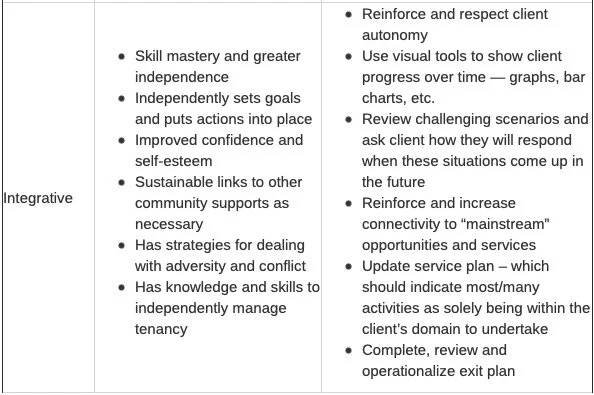
The key is to use the understanding of stages of change and objective-based home visits to assist clients in moving through the program stages.
You may also have noticed reference to things like the Crisis Plan and the Exit Plan, as well as Risk Assessment. If you want copies of any of these sorts of documents, drop me a note atidejong@orgcode.com
And there are, of course, other tools and techniques that you can put into place through each phase of the program to help track progress and work on increased success. Some of my favorites (click on any of them if you want more information from the source documents) include:
If we plan for success, have a sense of what to expect along the journey of housing and life stability, support appropriately without coercion or misguided expectations, use tools & strategies to increase the likelihood of success and remain focused on the major outcome of helping people achieve greater independence over time, more success will be had.
[serialposts]
Iain De Jong has considerable experience helping organizations better understand how to support clients in moving from one phase to the other, and thinking about resource allocation and time management of staff in supporting clients in each of the phases. Feel free to drop him a line or ask questions idejong@orgcode.com
Professional Works Gets Professional Results
[serialposts]
PART EIGHT: Professional Works Gets Professional Results
Successful housing programs have a professional orientation. Well-trained staff deliver the housing program. Successful housing programs tend not to be those operated in a charity context where “well intentioned” is sufficient to get the job done. There is too much at stake, and generally too much complexity for a layperson without training to help a client achieve long-term sustainability.
I am not anti-charity. There is a time and place for it. And in fact it is often charitable organizations that hire the professional staff to deliver the housing program. The mistake, however, is when untrained staff are directly involved in client interactions. Truth is, it can do more harm than good.
With the properly trained staff, housing programs get better outcomes. Here are some of the essential ingredients for ensuring your housing program is provided by professionals who get professional results.
Start with the Right Job Description
I love to take a poll when I do training about whether the job people are in with their organization is exactly how it sounded on paper when they applied. My non-scientific polling results would suggest that between 90-100% of people in any given audience say the job is different than how it looked in the job description.
I encourage organizations to pull together professionally polished and accurate job descriptions for their housing staff team. (You can learn more about the staff compliment for a successful housing team here.) Be clear on the qualifications that you want. Talk about the caseload size and what you expect to be done. Use data to describe the population base that will be served and the outputs and outcomes expected. Don’t sugarcoat the experience, because it is hard, hard work.
Knowledge Base
There are certain fundamentals that I would expect a candidate to have knowledge of prior to joining a high-functioning housing program. These would include the following:
Homelessness – history, context, local condition, causes, solutions, etc.
Poverty – economic, social, relational, causes, solutions, etc.
Health services – availability, access, major health conditions affecting persons who are homeless, etc.
Mental health services – availability, access, major mental health conditions prevalent amongst homeless populations, etc.
Addictions – cause of addictions, impact on behavior, responses to addiction (from prevention through to harm reduction), etc.
Housing – availability, cost, subsidies available, rental process, working with landlords, etc.
Income supports & benefits – application process, amount available, eligibility, budgeting on low income, etc.
Justice and Corrections – links between homelessness and conflict with the law, post-incarceration housing, discharge planning, etc.
Domestic violence – links between homeless and domestic violence, safe housing approaches, linking victim to appropriate therapeutic resources, housing abusers, etc.
Children’s services (if working with families) – requirements of families, impact of household composition and housing needs, supporting access to parenting resources, duty to report, etc.
Fetal Alcohol Spectrum Disorders – impact of FASD on decision-making and planning and behavior, linking to FAS resources, etc.
Brain injuries – working effectively with persons who have brain injuries and the impact brain injuries can have on decision-making, planning and behavior, etc.
Treatment protocols – understanding what treatment protocols are, how to work with medical staff, housing workers role in supporting treatment protocols, etc.
Medication management – awareness of medications common to the health and mental health issues common amongst the population and the impact of the medications, medication access and storage, etc.
Trauma – defining trauma, trauma informed service delivery, etc.
Gender – understanding gender as self-defined, gender lens to service delivery, etc.
Hoarding – detection, causes, effective strategies to organize possessions, etc.
Life changes – working through the life cycle and changes in household composition, etc.
Partying – causes of partying behavior, strategies to affect change so as to not negatively impact other tenants, etc.
Stages of Change – from pre-contemplation through to relapse, candidates should be able to rhyme off all of the stages of change, the genesis of the concept, how it applies to housing support work, etc.
Fundamentals of Case Management – understanding the history and core concepts of case management practices, client-centered and strength-based approaches to case management service delivery, documented service planning, etc.
As part of the housing team, while I would expect staff to have some understanding and technical proficiency in the areas outlined below, more exposure to how the organization delivers these skills in the context of the housing program can be necessary:
Brokering – comprehension of the difference between direct delivery of services compared to brokering access to services for clients, etc.
Advocacy – understanding when and how it is appropriate to advocate for a client, and the impacts of advocacy on the overall program, etc.
Goal setting – how to work with clients for them to establish clear, measurable goals to work on relative to housing and life stability, etc.
Documentation – when, where and how to document client interactions, how to store the information securely, who has access to documentation under what circumstances, etc.
Individuals Service Planning/Case planning – process of establishing specific, measurable, attainable, realistic and timed elements of a plan that will improve housing and life stability, etc.
Case conferencing – structure of pulling together other professionals and supports involved in the client’s case plan – as well as the client themselves – and the frequency, purpose and intent of doing so, etc.
Risk assessment – how the worker/organization works with the client to understand the people, processes or technology that may be necessary to ensure that the client does not negatively impact the community or worker or vice versa
Incident reporting – the documented process and information sharing protocol for when incidents occur involving clients, etc.
Harm to self or others – understanding the signs and assessments completed when a client may pose a risk to themselves or others, etc.
Conflict de-escalation and debriefing – understanding the strategies and techniques used to de-escalate conflict and how conflict is debriefed and learned from in the relationship with the client and across the staff team, etc.
Cultural awareness, competency and sensitivity – an appreciation of the ways in which culture informs how clients engage in supports, set goals, deal with conflict, socialize, etc.
From a health & safety and legal perspective I always encourage organizations to provide very clear evidence that each member of the staff team has demonstrated mastery in the following:
Community worker safety strategies – that each member of the staff team has been trained on how to increase their safety when working alone in the community; that there are adequate supervisory check-ins and awareness across the staff team of where people are at all times; and that each member of the staff team in each situation that they are in are cognizant of how to recognize potential risks and strategies to address those risks; etc.
First Aid and CPR – that each member of the staff team has current certification in the application of First Aid and CPR
Universal precautions – that each staff person knows how to use safety equipment as necessary when confronted with possible exposure to bodily fluids, and how to address risk factors appropriately
Relevant legislation – that the relevant legislation to the work has been identified and that each staff member is provided opportunities to stay current in the requirements of the legislation and associated regulations
Privacy and Confidentiality – that each staff member understands how information is collected, consents, storage of information, use of information and the proper procedures in the event that a third party (including police) request information or in the event that there is a privacy breach.
As a strong believer in evidence-based and evidence-informed practices, as part of a training plan, I would work towards ensuring professional excellence in the following at a minimum:
Motivational interviewing
Active listening
Wellness Recovery Action Plans
Assertive engagement
Integrated Dual Disorder Treatment
Supported Employment
Illness Management Recovery
Training
Professional people stay up to date in the main currents of thought and practice in their field. Training is one of the core ways of achieving this. While I appreciate it is not always practical, I do advocate that housing programs train as a team to ensure consistency throughout all of the staff.
High functioning housing programs have a training agenda set out a year in advance. There is a natural sequence to what people are expected to experience training at. When I help organizations set out their training agenda for the year, I also ensure that each one of the trainers is properly vetted and is aligned ideologically, strategically and operationally with what the organization is trying to achieve.
When helping to assemble a roster of trainers (outside of the training I deliver myself) I also look for trainers that understand adult learning strategies, are animated in their delivery and get trainees excited about learning. There should be well thought out content and take-aways for attendees.
Building consistency can also mean the use of highly skilled trainers on an ongoing professional development basis. Yes, it decreases diversity of messaging, but you can increase the quality of the training, relationship development with staff, trust building between trainee and trainer, and improve accountability for content delivery and improved professional practice based upon the content.
Given limited budgets, also approach the trainer in advance to see if you can tape them (audio or video). Some will allow it for free or a small fee on condition that you do not distribute it outside of your staff team.
In this day and age, not all training has to happen in person, and not all training has to take a half day, full day or multiple days. You may want to look for trainers that offer webinars through the likes of Go To Meeting or Go To Training or similar platforms, have podcasts, provide video materials, etc. This can make it a lot easier for scheduling and can also cut down on costs. I wouldn’t say exclusively to go this route, but it can and should be part of your overall approach.
Demonstrated Competencies
The demonstrated competencies pertain to both the application of the knowledge base outlined earlier in this blog, as well as how the staff team adheres to the service orientation necessary for effective service delivery.
Competencies are further demonstrated in how the staff member participates in the weekly case review and the objectives that they set out relative to the client’s identified needs, as well as the long term housing stability and improved quality of life achieved by the clients that they are serving. Team Leaders have to get out of the office – both in a scheduled and unscheduled manner – to support and work with their staff team to see core competencies in action.
Reflective Practitioners
As a professional practice, I expect the team members to be reflecting on how they are delivering their work, their training needs to improve practice and what their own internal data is telling them about their performance. There is a substantial difference between those housing teams that take the time out necessary to think and communicate about how and what they are doing and how to get better at their work, and those that just show up each day. Deliberate time is needed on a regular basis to think about practice and improvements. It is something that needs to happen throughout the staff team – not just at the supervisory/management level.
When I deliver Team Leader training one of the things that I spend a good chunk of time on is trying to teach the skills necessary to have staff teams becoming more reflective on their practice. This includes things like having other organizations speak with your clients and provide feedback on your service delivery (if you just asked your clients yourself they are more inclined to tell you that you are awesome than having a neutral party ask), how to encourage creative thinking and problem solving, to how to focus during self assessment and reflection, and how and when to use internal data.
Compensated Appropriately
Professional programs require an investment of resources so that the staff members receive the remuneration appropriate for their skill set and outputs and outcomes expected of them. I can’t say what that scale is in this blog because there are significant regional variations based upon a number of factors.
In surveys we have done with various staff teams throughout the world the lack of appropriate compensation is usually in the top three negative issues for staff. It can lead to turnover or resentment amongst the staff team. Or organizations feel that they are merely training staff who then leave to better paying positions in mental health facilities, hospitals, government, school boards, etc.
More than once I have been part of processes where individual non-profits have been offered more money to bring the pay up within their organization to be on par with other organizations in the same city or to bring pay up across the entire city for housing programs only to have Boards of Directors decline because they feel it would upset their own internal pay grade. Frustrating to be sure for everyone involved. But in part, I would argue, is that more education is needed on why and how this work is professionally different than some other roles within the organization or community at large.
Ethics and Boundaries
I wish I didn’t have to write this section. In various cities, I have either encountered or been asked to help problem solve a number of these types of ethical and/or boundary issues. It ranges from clients being brought to the case manager’s home for dinner several times per week, to requiring clients to babysit the case manager’s children, to odd jobs around the case manager’s house, to case managers that hug their clients, to case managers that perform fellatio to help their clients relax prior to apartment viewings, to case managers that use sex as a reward for progress in the service plan, and even case managers that have married clients. You may be shaking your head right now. I hope you are disgusted and outraged. It happens far too often.
As professionals we need to hold ourselves to a strict moral code in our work. We need to understand and appreciate the power differential that exists, and that we are required to be stewards of impeccable service. We also need to have appropriate, non-punitive outlets for staff who begin to feel conflicted with their boundaries to safely speak with someone before they act out and cross the line.
Turning Work Off
Given the nature of the work, the professionals involved need to deliberately practice self-care. We need to support the professionals in the work to recover emotionally and mentally from all that is seen and encountered in the nature of the work. We need staff to be able to distinguish between their professional time and their personal time.
Some housing programs based upon the nature of the clientele may offer some type of rotating on-call support across the staff team. Sometimes this is appropriate, but not always. I most definitely do not support the suggestion that all housing case manager supports have to keep their work phone on all day and night if they are not compensated to be on-call. I do not support work emails or documentation occurring in the evening hours when people are supposed to be off of work and enjoying activities and relationships outside of work. People who do this type of work most definitely need a life outside of work. Otherwise burn-out, inappropriate choices, resentment, workaholism, etc. can set in and the staff team becomes dysfunctional and unable to appropriately support staff. Professionals know the importance of “turning work off” when the work day is done.
Accountability
When we engage in professional practice we adamantly believe that there is value to our contributions to the lives of others…that our approach and training and skills result in something different than if people were solely served in a charity model. We must be able to demonstrate that the professional approach to work gets outputs and outcomes that are not attributable to chance – that there is a cause and effect relationship to the interventions that we support and the changes experienced in housing and life stability as a result.
We are accountable to the requirements of our job. As professionals we do not try to perform tasks outside of our area of expertise. We know when and how to integrate clients with other professional resources.
As professionals we look to our clients to provide feedback on the things that are working well and where they would like to see improvements. We look to our peers doing the same type of work to collaborate and share successful elements of practice rather than creating a monopoly of knowledge or a competitive culture across organizations.
As professionals we do not fear evaluation – we embrace it. Whether that is bringing in an outsider to examine and review the entire program from top to bottom, or having a “soft audit” across program areas within the same organization, what we want to do is instill a culture where there is viewed as helpful instead of threatening.
Successful housing program delivery is professional work. We need to appreciate, support and insist on professionalism across all organizations and staff delivering housing programs. The results will be improved greatly across the housing program as a result.
[serialposts]
Iain De Jong has established, evaluated and trained dozens of housing teams in various jurisdictions around the world. Grounded in evidence, pragmatism and liberal use of wit and humor, Iain’s housing programs have demonstrated success in program excellence and meeting the needs of their intended client base. If you would like to know more about these specific activities or the training program specifically for Team Leaders, drop him a note at idejong@orgcode.com