Objective-Based Home Visits
[serialposts]
PART SEVEN: Objective-Based Home Visits
Successful housing programs require case managers/housing support workers to visit their clients in their homes. You can’t have a successful housing program by having clients only come to your office. You can’t do it over the phone or by text message or email. Home visits are absolutely critical.
A common mistake that case managers make is to show up at a client’s home and say, “How are you today?” This type of open-ended question takes the conversation and purpose of the visit off the rails from the start. Yes, I want case managers to care about the welfare of their clients. Yes, I believe in conventional niceties in society. But I have very specific reasons for wanting Objective-Based Home Visits to be structured differently.
During the weekly case review meeting (as discussed in an earlier blog in this series) I want each case manager to identify the three objectives that they have for their next home visit. Each of these three objectives must be related to goals and anticipated outcomes identified in the individualized service plan. Some of these objectives may also be related to facilitating change with the client that is being supported. The objectives selected week to week will be directly related to the amount of time that the case manager and client have set aside for the meeting, as well as where the client is at in their service plan journey.
A conversation when a case manager shows up to conduct a home visit may open up with something like, “Iain, good to see you today. As we talked about last time, we have 30 minutes for this visit and I want to make sure we talk about ways that you can go about remembering your keys when you leave the apartment, make an appointment with Dr. Smith about your back pain and discuss the Fall Fair this weekend, which I think you might have a lot of fun attending.”
What this does is set the agenda for the interaction in a conversational style. Sure, the client (in this fictitious case surprisingly named Iain and spelled identical to my name) will have the opportunity to bring up other matters as time allows. The close of the meeting should also bring with it the opportunity for the client to talk about how they are doing, and at least in broad-strokes for the case manager and client to agree on what the objectives are for the next visit, as well as the day and amount of time needed for the next meeting.
At times, shorter meetings with smaller objectives may be appropriate. For example, “Iain, good to see you today. As we talked about last time, we have 10 minutes together for this visit and I want to follow-up to see if you mailed the postcard to your mom that you were planning on sending, drop off some information on free recreation programs at the community center that you may want to think about going to, and schedule a time with you to go grocery shopping together on Friday.”
And, of course at other times there will be longer meetings with some larger objectives. For example, “Iain, good to see you today. As we talked about last time, I have set aside an hour for us to spend together today to help you plan for your upcoming supervised visit with your son, complete some forms to apply for the disability benefits that you wanted to try and get, and schedule a time for later in this week for us to go to the library.”
By no means mandatory, but I have found that for longer meetings it can be helpful to have some activities to do while having the discussion about the other items. Depending on specific client situations, it can be a great opportunity to teach and model other skills. For example, the case manager and client could do a load of dishes together or do some general tidying or water plants or make some meals that can be frozen while discussing the objectives for the visit. Just ideas – and it will depend on what is appropriate in each different client scenario – but it can be disarming for the client and create a natural discussion environment while also increasing the benefits of the longer interaction. Plus, it can make the time go by quicker for everyone involved.
There are other benefits to Objective Based Home Visits as well.
Objective Based Home Visits improve time management for both case managers and clients.
For the client, when they know in advance when the visit is going to occur and how much time is going to be required they can schedule it in amongst other activities that they may be engaged in. It is my experience that clients miss fewer home visits when they know not only when it is going to occur, but how long it is going to take. For the case manager, they can better schedule their days in advance on what is achievable. Maybe the case manager wants to group together visits in the same part of the city on the same day. Maybe the case manager functions well when, say Mondays and Fridays are spent with a series of quicker visits and Tuesdays, Wednesday and Thursdays are best used for more in-depth visits. With about 20 people on a caseload at various stages of moving towards greater independence, this time management piece alone can be the difference between burning out or staying balanced for a case manager.
Objective Based Home Visits increase accountability and make it easier to measure progress.
Because the objectives are set out in advance of the meeting with the client, and because they are recorded as part of the weekly case review meeting, it is a lot easier to track whether these objectives relative to the case plan goals and intended outcomes are being met. It helps ensure ongoing progress relative to change and support in the client’s life. This type of measurement and accountability also allows the client to more easily see and feel that they are making progress. It can also help Team Leaders in coaching their case management staff to success in client interactions.
Objective Based Home Visits help ensure that the housing support program does not become a crisis support program.
Too many times I have seen what are supposed to be case management staff scrambling from one hot button issue to another with clients that they are supposed to be supporting in a case management function, not as a crisis support worker. I would argue that this happens for three reasons:
when the client entered the program it was not adequately explained to them how the case management services work and the structure of home visits;
without using objective based home visits and the time management elements associated with it there are some clients seen less frequently, which can create an environment where things can go off the rails without support;
it has not been explicitly explained to clients that this is a support service where there are goals set out and objectives for each interaction, and they therefore erroneously think the program has a crisis service element.
To be clear, there are great crisis services that do phenomenal work, and they are an important service to have in a community; however, the housing support program with its structured case planning and objective-based home visits is not a crisis service. Case managers should not be de-railed by crises. They should be able to plot their week out in advance, knowing which clients they are going to see at what times and what the objectives are for each interaction with those clients.
Objective Based Home Visits provide clearer direction for moving towards greater independence over time, and assists in moving through plateaus.
Related to accountability, the Objective Based Home Visit helps create an environment where there is steady progress in the service plan support process. The intent of providing supports is to promote greater independence over time. Does that mean that everyone will achieve complete independence? No. But in the case management process we can increasingly work towards helping the clients integrate with other community supports. We do not want there to be a culture of dependence created between the case manager and the client.
Even with the best case managers and most motivated clients I have seen instances where clients seem to reach a plateau in making progress towards greater housing stability and improved life stability. It has been described to me as “the case management stopped working”. We don’t want clients to experience relapse because of the frustration of feeling “stuck”. We also don’t want them to drop out of the support program as a result of their frustration. Objective Based Home Visits can be of tremendous assistance in these instances, as it allows for a multitude of strategies, actions and ideas that all remain connected to the service plan, but which encourage and allow for creativity.
When Assertive Engagement techniques are necessary, Objective Based Home Visits can help structure the conversation and get the supports back on track.
Assertive Engagement techniques are necessary in some instances when working with clients. One of the most powerful techniques that can be used when breaking through the support barriers that precipitated the need to use Assertive Engagement techniques is the use of an objective-based approach – even when/if the exchange with the individual is not at their home. Too often I have seen case managers pretty much scold their clients for being disengaged when they employ Assertive Engagement techniques. I would say that is unfortunate. Whether you are locating the client at a coffee shop or drop-in center or bottle depot or wherever in the use of Assertive Engagement, I would still focus the conversation the same… “Iain, good to see you and I am glad were able to connect with each other today. Now that we have found each other, let’s spend ten minutes scheduling a time when we can both commit to meeting at your apartment, talk about the three things we should focus our time on when we meet at your apartment, and I want to give you some information for you to look at about a new free dental clinic that opened up.”
Objective Based Home Visits can help encourage meaningful daily activities and improve healthy social networks.
One of the very positive results of an Objective Based Home Visit approach is that it has proven to be very effective at helping clients engage in meaningful daily activities outside of the service plan activities. This includes things like community events, libraries, engaging at a local college, social clubs, volunteering, engaging with places of worship, etc. If a client is experiencing social isolation (which can result in them choosing to leave their apartment) the objective-based approach creates an environment where the case manager can suggest and assist with structuring other opportunities for the client. This allows the client to also (re)create a healthy social network, which is critical for ongoing informal supports.
As this blog has gone to great lengths to demonstrate, home visits are not a casual check-in. Nor is each home visit intended to be a marathon session that addresses every issue under the sun. The Objective Based Home Visit approach provides important structure to working effectively with clients, balances the objectives relative to time availability, moves away from a crisis orientation in service delivery and improves connectivity with the case manager as the client works towards achieving greater independence. The Objective Based Home Visit approach allows for a “small wins” approach to be taken in the service plan process, and is naturally aligned with demonstrating ongoing progress in the service plan process incrementally.
[serialposts]
Iain De Jong teaches half-day seminars in person and through the web on improving service delivery to clients through the use of Objective-Based Home Visits. Home visits generally have proven to be necessary for successful housing programs. Making sure there are three objectives per visit provides a structure and focus that brings it to the next level. If you have questions or would be interested in learning more about Objective Based Home Visits, drop Iain a note at idejong@orgcode.com
Using Data to Drive Program Improvements
[serialposts]
PART SIX: Using Data to Drive Program Improvements
Data. I know it is a four-letter word. It makes policy wonks salivate lustfully and makes many front-line practitioners run for the hills (or the bottle).
Truth is, data doesn’t have to be scary or cumbersome or a nuisance. Done right, data is the ace up your sleeve to make your program transition from good to great.
As a starting point, know that there are resources out there that can help you if you are unfamiliar or uncomfortable with data. The National Alliance to End Homelessness has a range of nifty resources. I especially like What Gets Measured Gets Done. Data and performance measurement is also a subject matter I get asked to speak about a lot. So, if you want to check out some ofthat – littered with “Iain-isms” – feel free. Plus there are a few previous blogs (not part of this current series) where I have talked about performance measurement, data and organizing information in the context of functioning like a system instead of a collection of projects. This one in particular is short and the feedback we’ve received suggests it is my most entertaining blog entry (fire alarms, vibrating bed, strobe lights, knocks on the door in the middle of the night – how can you go wrong?). A couple of other articles may be a useful read if you are unfamiliar with some of the core concepts of data and performance management, or want to better understand how measurement improves organizational learning.
Now onto the matter at hand – driving program improvements through the use of data.
Collect the Right Data at Intake and Assessment to Help the Person/Family Get to the Right Program to Meet their Needs
I think a lot of intake and assessment processes can use refinement. Too often there is a “deep dive” into information that is completely unrelated to determining which housing program is best going to meet an individual’s/family’s needs. It can also be problematic to not have effective screening tools prior to going deeply into the intake and assessment.
Remember that an intake and assessment process should be about the client. It isn’t about the organization. It is about meeting their needs. It is about offering the right housing program choices based upon the needs they present.
We strongly recommend the use of the Service Prioritization Decision Assistance Tool to improve intake and assessment. To be transparent, we created it. But, it was created through a very thorough process with lots of vetting and research. And most of all we can PROVE that housing retention, client satisfaction and case manager satisfaction all increase through the use of the tool when compared to other tools, self-sufficiency matrices or no tool at all. The tool is now in use with over 70 communities across the world, been endorsed by various government entities and been supported by psychiatric consumer survivor groups.
Collect only What you NEED to Collect
More data is not better data. Twice as much is not necessarily twice as good.
So what is NEEDED?
You need basic (stress ‘basic’) demographic data and information that will help inform what the best housing program will be. Other information may be collected during a case management or support function; collecting that during intake and assessment is not necessary. In fact, I would argue it is unnecessarily intrusive.
High-functioning non-profits (and not just in the housing and homeless sector) have learned the lesson that less is more when it comes to data collection. Take for example Strive in Cincinnati. They went from about 150 data points down to about 10 that they felt were most important for their work. Dramatic decrease with remarkable increased performance (and buy-in).
Ask Yourself the “So What?” Question
I tell people repeatedly that we need to see our work in housing and homeless service delivery as QUALITY work, not QUANTITY work. I realize getting this message across to funders and politicians can be especially difficult. On a recent speaking tour throughout Minnesota I was bombarded with questions about the tension between what funders ask for and what organizations think they can deliver in a meaningful way. Many organizations feel pressured to serve more and more people, rather than focusing on a smaller number of people and serving them really, really well (so well in fact that they don’t become homeless again).
Which leads me to the “So What?” question.
Every organization needs to ask themselves the question of what difference they are actually making. For example: Organization X boasts that they housed 100 people last year. I ask, so what? Did they remain housed? Did the quality of their lives improve? Was there a positive impact on the community at large? What did it take (from a resource perspective) to achieve the work, and how much is it going to require on an ongoing basis? Why those 100 people and not a different 100 people – what selection process and prioritization process did you use and why?
Listen to Your Entire Staff Team & Build the Data Collection Requirements Across Organizations
There is some pretty interesting research that has explored the effectiveness of performance measurement systems when they are imposed down through a hierarchy as opposed to generated collaboratively (see for example Eckhart-Queenan’s work). There has been some other research that has explored the notion of trust as an important ingredient for successful performance management systems.
I highly recommend that on each staff team, everyone should be involved in the creation of the program logic model. It should not be something that happens in a back-room function solely as part of a funding application. Make it transparent and operational.
When building data collection requirements across a system, I strongly recommend the involvement of multiple organizations in the development of the approach and metrics. As we have done in our recent work in Detroit with the Homeless Action Network of Detroit, this is a three pronged process: conduct a survey to understand how people currently feel about data and how they use it; map out the existing array of services from the perspective of the client, from opportunities for diversion/prevention right through to how we support and monitor housing retention after they successfully exit the program; and, then have the community draft out the metrics that they think are important for each program area within the service system.
Your HMIS is NOT Your Performance Measurement System
Your HMIS is a place to store data and run reports on your data. That is awesome… if data entry is complete and there is a thoughtful data analysis plan. It also helps when it is an open system as opposed to a closed system.
Truth is, the HMIS presents information. It does not interpret information. That is up to you. The question you need to be able to answer from that which is included in the HMIS is What does this mean?
Don’t Just Do What your Funder Demands
Better data allows organizations to better influence the sort of information that funders look at as well as how they interpret it. For this reason – but not this reason alone – I am an advocate for organizations collecting not just what funders demand as a condition of receiving funds. Organizations should also collect the data they need to internally reflect on their program, what is working/not working (and why) and what they may want to consider doing differently.
Use The Data All Over the Place & Present it in Different Ways
Want buy in on data? Use it all over the place…staff meetings, newsletters, website, community meetings, board meetings, Facebook, that annoying spiel you here when you are waiting for someone to pick up their phone, Twitter, bulletin boards, plaques by the reception area, etc.
Too often, data is seen as something that drifts into a black hole never to be seen again. Or when it does emerge seems to be months or years after the fact. Bad idea. Bring the data to life. The way to do that is to use it in a timely way and plaster it all over the place. Everyone will know your organization and who visits your organization will know you are serious about data and performance if you do these things.
Also, remember that people learn in different ways and will respond to your data depending on how you present it. Consider different approaches – graphs, charts, infographics, trend analysis, narratives, etc. Don’t just hand out spreadsheets and expect people to do cartwheels.
Inputting Data is Part of the Real Work
If you want data to drive program improvements, the data has to actually exist, right? How many organizations reading this have one or more staff person who is behind in their data entry, despite frequent reminders/requests?
Every high performing housing program I have been a part of or evaluated sets aside work time within each and every day that is solely related to entering data and case notes. Nothing else. Not general admin time. It is data and information time. These organizations tend to have up to date data within their systems within 24 hours of client interactions.
Data and information entry is part of the real work done in housing programs. It is not something that happens when time allows or only when there are no direct service demands from clients. It can be a huge cultural change, but timely data entry is critical for housing program success.
Having a Meaningful Data Typology & Data Analysis Plan
If you create the right pieces of information in the right ways you will never need to hire a high-priced consultant, academic or analyst to make sense of your data (many of whom would just look at your watch and tell you what time it is anyway).
This means, however, that you need to invest time and energy thinking in advance about what progress reports and analysis you want to create at what time intervals, and what data manipulations or calculations will be required for that to happen. The more you think about this in advance and plan in advance, the more consistent you will become in the use of data (reports get run when they are supposed to get run) and your have focused attention not on all possible types of analysis that are possible, but rather the pieces of information that are most important to understanding if your housing program is working/not working, and for which populations and why.
The data typology simply refers to how you organize your data. Common ways are things like gender, age of clients, length of time homeless, veteran or non-veteran, ethno-racial identity, service entry point and the like.
The data analysis plan tells you how you find the answers to the questions you are asking. For example, if it is important to your organization to know how female veterans under the age of 30 are doing in housing compared to female non-veterans within the same age cohort you’d set up the queries necessary in advance to answer that very question on an ongoing basis.
Keep it Simple
The more simple you keep the data collection, analysis and dissemination of the data, the more buy-in there is going to be to data overall. If people feel that PhD’s need to muck about to make sense of the information, the day to day operational importance of the data has likely been lost. Everyone in your housing program should know exactly what the data being collected is, why it is important and what it is intended to measure. If they don’t all understand then you need to keep breaking it down until it is simply understood by one and all.
Don’t Ignore the Data if it Tells You Something You Didn’t Want to Know
Over the past 20 years working on various social justice projects it would seem to me that organizations love and celebrate their data when it seems to demonstrate that they are doing a good job and supports the narrative of what it is they say they are doing. BUT, many of these same organizations have a tendency to distance themselves from data if they think it presents any sort of picture that would somehow diminish their feeling of awesomeness.
Truth is, awesome organizations embrace continuous improvement not as a management buzz-phrase, but as something integral to their organizational DNA. Those organizations look at all data, but particularly like the data that suggests maybe their programs are not performing well. Then they can use data to reflect on practice and make substantial improvements, rather than continuing to deliver the same programs in the same ways with the same poor – or even just average – results.
Set Meaningful Indicators and Targets
Targets should never be an aspiration. They should be what you think the housing program can reasonably achieve with the resources available and within the specific operational climate. Unrealistic targets are a recipe for alienating people from wanting to collect and use data.
Indicators tell us the information we need relative to the targets. If we aren’t looking at the right things we’ll never know if the targets are being achieved. The two (indicators and targets) require a strong marriage.
I am a fan of creating indicators and targets within sectors of service as opposed to for specific projects. For example, I would suggest a minimum threshold in each of the following: outreach; emergency shelter; drop-in centers; employment & income; prevention & diversion; interim housing; permanent supportive housing; and, rapid re-housing. This allows for greater consistency within sectors of service, helps structure the services into a system model, but most importantly in the context of this blog allows us to track data that demonstrates that each of these sectors of service plays a role in ending homelessness. (And by the way, housing is the only known cure to homelessness, so surely to God – or the deity of your choosing – indicators and targets should have a housing orientation.)
Focusing on these areas of data will improve performance and drive the right performance changes within your housing programs. Ignoring information or working solely from intuition is not a recipe for success. If ignorance is bliss, then there are far too many organizations that are orgasmic. We need dedicated and purposeful attention paid to the importance of data and how it makes us all better practitioners. That which we think can be different from that which we know – and data helps us figure out the difference.
[serialposts]
Iain De Jong is a data nerd to the nth degree. He is always looking for kindred spirits who share his passion for making data and performance management cool. More than a third of his professional work is related to data and performance systems, both re-constructing them as well as keynote speaking and seminars to get people pumped up about the opportunities that data truly presents. If you share his passion for data or want to explore specific pieces of information that should be collected and analyzed relative to your specific program, let him know atidejong@orgcode.com
Helping Landlords Help You
[serialposts]
PART FIVE: Helping Landlords Help You
There should be a range of housing options for clients of your housing program to consider. In the best of circumstances this will include everything from permanent supportive housing to private market housing (with or without vouchers or rent supplements) and public/social housing. It will hopefully include a wide variety of units from multi-unit residential buildings to suites in the secondary market like basement suites or rented houses. It may also include the likes of well-maintained and managed rooming houses or boarding homes. And I could go on with the diverse types of housing. The key is to have a range of options that clients can CHOOSE from.
Choice is fundamental to housing program success. If your organization does housing placements instead of offering housing choices, you are missing an important part of program success. Inone research study it found that clients who felt that they had a choice in where they lived were most happy with their housing, whereas those who felt that had less choice were much less happy with their housing. The latter is also more likely to move and/or experience a return to homelessness.
For the purpose of this blog, I want to focus attention on working with private market landlords – even if your organization does not have access to any type of financial assistance to provide to landlords. In a perfect world there would be an infinite number of subsidies to provide; immediate access to subsidized housing; a balanced (or renter-friendly) vacancy rate; and rental rates comparable to the financial benefits that poor people receive on welfare. The reality, though, is that this is not the case. So here are some approaches that have proven to be effective in an imperfect world to gain access to units in the private market, often at a reduced rate.
As I mentioned in a previous part of the series, social workers tend not to make great landlords and landlords tend not to be great social workers. Sure, there are exceptions, but I think you would agree with me that these are separate disciplines.
It may be nice to think that landlords want to rent to your clients because they have big hearts and want to make a huge difference in their community. And sure, there may be some like this in your community. However, it is generally my experience that housing programs are more successful when you attempt to meet landlords where they are at and meet their interests, rather than vice versa.
Landlords are in the business of making money. Helping landlords make more money is entirely possible by you, even without subsidies. Consider some of the things that cost landlords money: underperforming parts of their building portfolio; vacancy loss for unrented units; rent collection; advertising; showing units; and, preparing units as part of turnover.
Larger landlords (or property management firms) that have several buildings in their portfolio are likely to have one or more buildings – or a small grouping of units within some buildings – that are underperforming. These are buildings/units that experience greater degree of turnover and more vacancy loss. When approaching prospective landlords, keep this in mind. Part of your pitch should be that you want to help them rent out units in parts of their portfolio that are underperforming. (To be clear, this doesn’t mean there is anything physically wrong with the units. All units should be in habitable condition.)
Further to this, when approaching landlords ask them if there are specific units where they experience greater vacancy loss. This is like the previous paragraph on underperforming parts of the portfolio. Approaching at this angle, the question you may want to ask landlords is, “Would you like greater revenue stability (or predictability) from some of your units that frequently go vacant?”
It is fair to say that all landlords, regardless of size, expend resources to collect rent. There are bookkeeping and accounting aspects of this task. There can be person-hours spent knocking on doors and trying to track tenants down who didn’t show up at a rental office to submit their rent. Here, again, you can help landlords. Whenever possible, have your clients hooked up with third party rent payments directly to the landlord. (As an aside, I think this is analogous to how my mortgage gets paid – directly from my bank account to my lender.) This can come from income supports or even an employer. What it tends to mean is a predictable process for landlords to receive rent payments with less resources expended.
Related to payment of rent, every housing program that I am a part of requires the client support worker to contact each of their landlords by the fifth business day of every month to ensure that the landlord received their rent on time and in full. Even with third party payment of rent, I find that doing this decreases issues that may stem from some sort of bureaucratic glitch. It also creates another communication vehicle for the landlord to share their insights on particular tenant situations.
To streamline communication – thereby also reducing potential person hour expenses for the landlord – have the Housing Locator staff person on your team be the only phone number and name that a landlord has to keep handy if they want to call to talk about an issue or even praise of how well things are going. It is not helpful to landlords to have a list of five or ten or even more workers that they have to keep straight from across multiple organizations related to tenants in their buildings that are involved in your housing program.
In communities where there are multiple housing programs operating, I strongly suggest that Housing Locators work cooperatively rather than competitively. To some this is going to sound threatening, and I have heard people say many times, “I’m not going to share my landlord list with (insert name of person or organization here)”. But the reality is, in the same way that landlords shouldn’t have to keep track of multiple housing support workers, they can equally despise having numerous Housing Locators contacting them from different organizations about the same pocket of units. I have seen some communities where the Housing Locator function has even been centralized across different organizations to tackle this very issue.
I never advocate for a landlord to provide all of their vacancy to one organization or to one program. A general rule of thumb is that unless there are permanent supports on site 24 hours a day, no more than 15% of the units in any given building should be occupied by tenants actively receiving case management supports. More than that and the general composition and character of the building can change. (This was a particularly painful lesson to learn as a practitioner.) The place I want to get to with landlords, however is for them to offer a program a predictable number of units across their portfolio on either a monthly or annual basis. This makes it easier to plan and create choices for clients. It allows the landlord to make informed choices about what part of their portfolio they want to strategically target. It also decreases their advertising costs and can reduce unit showing costs because they have greater say in when and how units are shown. (In a few situations I have even seen landlords that have the housing support workers or Housing Locators show the units to their clients without a superintendent present…though I have mixed feelings about this.)
A popular question/concern is about damage that may be caused to a unit. This relates to damage inflicted by a client, not the usual wear and tear that may occur regardless of who the tenant is. There are a few things that I have found to be very helpful in decreasing the likelihood of damages:
Ensure clients are making an informed choice of where they want to live. My experience as a practitioner suggests that the more choice people have, the more pride in their unit they have and the less damage that occurs.
Make sure the client has their basic needs met in the apartment on the day of move in (furnishings, food, cleaning supplies, etc.). If you really want the client to feel like they are creating a place of their own, allow them to pick out the furnishings that they want.
Focus on the activities that may be necessary to help convert the apartment into a home as one of the first meaningful daily activities that you encourage with the client. This includes things like putting up knick-knacks, photos of important people in their life, plants, newspaper clippings or posters, etc.
Ask the client before they move in “What do you think it means to be a responsible tenant?” Ask them that again when they move in and around the first time that rent is due.
Have housing support workers/case managers knock on the superintendent’s door (if there is a super on site) every time they go to visit a client just to let them know that they are around. This gives the superintendent a chance to bring up any issues. It also gives the landlord assurance that you are doing what you said you’d be doing and providing on-site supports.
Deliver supports in the client’s home. This gives you a chance to see first hand the condition of the unit.
If there is minor damage (e.g., a hole punched in the wall; a cupboard door ripped off) ask the client “How do you think you should go about telling the landlord about this? What would be a good outcome of telling the landlord about it? What do you think would be appropriate compensation or repayment for the damages? How might you convince the landlord that this won’t happen again?” (I can’t tell you how many times I have seen this save a tenancy.)
As the leader of a very large housing program, I had a small pocket of resources for exceptional circumstances. It amounted to about $20,000 a year that I could draw from. I used it only in exceptional circumstances and I never advertised to landlords that the pocket of money existed. Never did I spend the $20,000 in any given year. I attribute this to the suggestions and tips noted above.
When I first approach landlords about accessing units in their portfolio, I don’t start with a pitch that focuses on housing homeless people. I had a phenomenal Housing Locator once with incredible business savvy who taught me that was a dead-end before going any further. What I learned was to focus on a pool of tenants that I had access to which could help them meet their business objectives. I learned to focus part of the conversation to be about how all of the prospective tenants we had to offer them came with supports to help negotiate situations that may arise, which is something that their other tenants did not have. I also learned about pitching the direct payment of rent. The closing of the pitch – which again I learned from a masterful person who knew the ins and outs of the industry – was to ask the landlords to let us vet the potential tenants to be the right fit for their buildings…that they didn’t need to worry about credit checks or references, which would just be more time consuming on their end.
There are differing views in housing programs about the lease structure with the landlords. Some programs like to use head leases whereby the non-profit agency enters into the legal contract with the landlord for the unit and the clients, in essence, become sub-leasers. For those organizations that are happy with that and have the insurance to cover that sort of liability, I can see how it can be successful. My preference, however, is always to see the lease directly between the landlord and the client. For one, I think it further empowers the client. For another – and very practically speaking – it decreases potential liability in the off chance that something goes terribly wrong with the unit.
Maintaining the relationship with landlords is the next key. As previously mentioned, I want support workers to make sure rent is paid each month and to stop by and say hello when there is an on-site superintendent. I want everyone to be clear that we are never going to divulge private information about the tenant. What this attempts to do is create a forum where the landlord or superintendent can share information with us and gives them a sense of certainty that when we say our clients have supports, they can actually see the support person. I have also found it very effective, however, to create a landlord roundtable. About four times a year I advocate for bringing together all of the landlords involved with the program and structure an agenda where they can talk about both issues and solutions. Truth be told, the first few meetings will be littered with some program complaints. And landlords that attend the meeting have to know that you cannot and will not talk about issues regarding a specific tenant. There is something magical that happens a few meetings in, however, where landlords start to share ideas about addressing common issues as well as celebrating program successes. I have seen some landlord roundtables where a landlord become a co-chair of the meetings as well. This can be very effective.
I know that when housing programs see landlords as a program partner as opposed to just a resource to be consumed they get more access to units, more effective problem-solving and can also get positive press and accolades from within the landlord community. I remember when the World Habitat Awards were reviewing a program that I was operating, the endorsement of some of the landlords they spoke with was one of the overwhelming positives that the evaluators took away from the experience. I also remain grateful that when I was first starting a rather successful housing program and using this approach that it was the landlord community that got behind the approach early and encouraged their colleagues (and competitors) to get involved because they saw it as a good business relationship with good communication. This was in an environment with very low vacancy rates and high rents. We were able to negotiate rent reductions in exchange for helping them with underperforming parts of their portfolio.
I am not so naïve as to think that all landlord relationships are going to be perfect. They aren’t. As a very pragmatic practitioner, I also know, however, that there are a lot of landlords out there eager to maximize the profit potential of their portfolio. I have seen how reducing vacancy loss can result in rent reductions. I have seen effective problem solving rather than evictions when there are damages caused. I have seen communities actually become healthier with the addition of housing program tenants. Landlords should be seen as a partner in the process. Without them having an effective housing program is going to be very, very difficult.
[serialposts]
Iain De Jong has assisted many communities that operate housing programs in tapping into the potential within the local housing market, regardless of vacancy rates or average rents. With a strong business perspective and the view that landlords are a partner, not just a resource to be consumed, the relationship can be an ongoing positive and proactive one, working to the benefit of the landlord community and people seeking housing. If you’d like to learn more about the approach or various business models that can be used to make a pitch to landlords, drop Iain a note atidejong@orgcode.com
The 5 Essential and Sequential Elements
[serialposts]
In the fourth part of the series we look at the sequence of events that needs to occur for housing programs to be successful.
PART FOUR: The 5 Essential and Sequential Elements
Regardless of the presenting needs and complexity of issues, housing programs always function best when housing is the first task to focus on. Throughout my travels I have seen far too great an emphasis on trying to get a case plan in place prior to getting someone housed…or getting the client into treatment first…or getting the client compliant with medication first – and I could go on. It doesn’t matter if you are a fan of Housing First or not – what is critically clear through the evaluations we have performed and my years of professional practice is that housing has to be the first thing worked on or else the rest of the tasks are not going to be successful in helping people achieve housing stability.
So, here are the 5 Essential and Sequential Elements of Successful housing programs.
Focus on Housing Before Anything Else
Create an Individualized Service Plan
Increase Self Awareness
Support Achievements in Self Management
Allow the Client to Reframe/Rebuild One’s Life and Future
Now let’s look at the critical components of each one:
1. Focus on Housing Before Anything Else
We need to have a range of housing choices for people to consider. This will cover things like permanent supportive housing, scattered site market housing with supports, and perhaps things like well managed boarding homes or rooming houses or even secondary suites like basement apartments. After we have presented a range of choices and the client has selected a place and the lease is in place, the critical components for the housing to be successful (as a first step in a process) are:
Relationships – creating an environment of awareness about the relationships that the client has with others in their life and how those relationships may support or create conflict in keeping their housing. They may have family and friends that are supportive and healthy relationships that will make the reintegration process easier. On the other hand, they may have some pals from the street or shelter that they want to invite back to their place – maybe even offer them their floor or couch to sleep on. This may have deleterious consequences depending on how many of these folks we are talking about, behaviors and their relationship to the person we are supporting. We need to create the opportunity for meaningful conversation about relationships relative to maintaining housing.
Basic Needs – we never want someone to move into a place where the basic needs aren’t in place. On the day of the move in (and I stress “the day of” not “soon after”) the apartment should be furnished (preferably with furniture of the client’s choosing), there should be food in the cupboards and fridge and basic cleaning supplies should be in place. Meet these basic needs in the apartment and the client is going to be more inclined to stay in their place.
Supports – we should ensure that the client is aware of the supports available to them. In a lot of instances this is going to be a case manager of follow-up support worker of some kind. Regardless of the type of support, the client should know when and how to contact the person(s) who are providing support and what they can expect when they seek support. Given superintendents/landlords also play a support role to all tenants in their building, it is important than the client understand what the superintendent/landlord role is as well. We also need to distinguish crisis supports that may be available from case management and other types of less intensive supports that may be available.
Safety – all prospective places that people move into should be in habitable condition and be safe. Clients should have doors that they can lock to keep the world out if they so choose. They should also have windows that close so as to avoid intrusions that way as well. We want our clients to feel that their place is their home; that they can decide who they let into their home and who they keep out.
2. Create an Individualized Service Plan
AFTER the person is in housing is when the individualized service plan should be created (not before). My preference is to call it an individualized service plan rather than a case plan – but that’s just me. This is the document where the client outlines what they want to work on in partnership with their supports so that their housing remains stable. I don’t believe there is anything cookie cutter about these documents. I certainly don’t support a checklist type approach to pulling them together or putting in place predetermined/required goals that the client has never agreed to (SOAP BOX MOMENT – I may blow a gasket if I see another one of these documents where the agency has put sobriety, treatment or meeting with a psychiatrist in as a goal for the client when they have never agreed to wanting to achieve these things….but I digress).
Individualized service plans tend to work best when these have these components:
Life Stability – I like to see the goals and activities related to life stability to be situated in a context of housing stability rather than stand-alones. The reason for this is that I want to see people reflecting on how to sustainably stay in housing while they work on whatever other areas of their life they think are important to work on.
Meaningful Daily Activities – everybody should have things that they do to occupy their time that isn’t used by other service plan activities like meeting with doctors or income supports or those sorts of things. Worst thing is people who sit around with nothing to do and are completely socially isolated. We need to make a strong effort to increase awareness and opportunities for the clients that we serve that gets them into an environment ripe for community integration. Most often this will be most days of the week, ideally, and will provide good satisfaction and fulfillment – whether that fulfillment be emotional, spiritual, social, recreational, intellectual, etc.
Education and/or Employment – indeed education and employment may be types of meaningful daily activities that a client engages with. However, I keep these separate because of all that has been learned from the likes of supported employment and from different research that has occurred on recovery services that show these as two positive stand-alone components.
Connections with Other Systems – in many cases the people that we serve will also have connections with the likes of doctors, psychiatrists, parole officers, therapists and others. Given we don’t have control over these other systems, we need to focus our attention on connecting to these other systems in a way that works to the benefit of the people that we serve. This can take a range of approaches, but the advice I always provide is to have formalized brokered access to services rather than the system connections being a series of one-offs. Connecting at a policy and senior management level in addition to the operational level is preferred.
Social Awareness – to assist the people we serve in moving beyond their identity as a “formerly homeless person” we need to help create environments where they connect with people across a broad range of income strata and life experiences. We also want to create opportunities for people to potentially become more comfortable and confident in meeting with other professionals – like, say, biding time in a waiting room while waiting to be seen by a dentist.
3. Increase Self Awareness
Self-awareness calls for use of introspection skills and the ability to become attuned to one’s knowledge, values, opinions and beliefs. Self-awareness allows for “ownership” of these feelings and the ability to put into context what one beliefs relative to what others may think, the influences used by others and the environment within which one lives. I would argue that for many of the people we serve – especially those that have experienced long-term homelessness or long-term institutional living – that self awareness becomes compromised because they are socialized (or even forced) to think and behave in certain ways as a requirement for receiving services. Further, I would argue that some of the behaviors exhibited by the people we serve that seem to have negative consequences on their life in the past are directly related to imposed reduced self awareness.
Helping the people we work with increase their self-awareness requires focused attention on three components:
Self-Assessment – this is intuitive to many people, as a function of how we interpret a broad range of stimuli, the situation we are in and information we are presented with – and then determine the most appropriate behavior relative to the circumstances. Self-assessment is really an identity aspect of our personality. People who have been subjected to being told what to do for long periods of time rather than independent analysis of a situation can have their self-assessment skills compromised. Some of the people we work with will need help re-establishing the skills of reflection on circumstance and environment and thinking critically through the most appropriate responses to the various stimuli and emotions felt in the situation. Open ended questions related to specific circumstances are best for helping to build this skill set.
Triggers – this relates to understanding how certain responses or behaviors directly relate to various stimuli, emotions, situations or circumstances. A deeper understanding of the triggers that related to how and why they became homeless in the past can help with planning for greater housing stability on an ongoing basis. Reflecting on specific situations can be helpful for assisting our clients identify their triggers.
Confidence – reinforcing positive growth in self-assessment increased confidence. Confidence becomes important in calculated risk-taking in growth and personal change related to the individualized case plan. It can also help with emotional strength and resiliency, as well as problem-solving that still keeps housing stability at the center of deliberations of how to respond to various situations.
4. Support Achievements in Self Management
Self Management in this context refers to working collaboratively with a range of supports and information for more holistic and informed decision-making. This is linked to how one cares for oneself along various dimensions: emotionally, physically, spiritually, socially, intellectually, etc. Our role can be to provide support and education to the people that we work with to help them establish the means through which they can exercise self management. Of importance here is that we do not enter into a dependent relationship where we are somehow at the center of the decision-making structure. We want to encourage the individuals to seek out other resources and information to make decisions so that they can do so independently of us in the future.
There are three components to supporting achievements in self management:
Control – we want people to experiment with and exercise greater control in their own life. This relates to where and how they get information that relates to their decision-making, how they respond to the decisions they have made, which individuals they invite into their life to be part of the information collection process, etc. What we are trying to reinforce is that the client is in control of their service plan, their decisions, their own future.
Accountability – as an extension of exercising control, individuals should be in a position to accept greater accountability for the information they are using and the decisions that they are making. Because our service orientation is focused on the individual and we are not using any type of cookie-cutter approach, it becomes important for the individual to exercise self-accountability. Ultimately we want the people we work with to feel accountable for their successes, as well as when things did not go as planned. The accountability in the latter is how we can facilitate a discussion about what they can learn from the experience.
Optimism – exercising self management should lead to feelings of optimism. We want the people we serve to feel control over their lives and accountable for the decisions they are making, all with a feeling that the future (whether that is tomorrow, next week, next month or years from now) are worth looking forward to and working hard to make better. Optimism is fueled by meaningful reflection on what has been achieved. It is for this reason that we need to take time to also work with our clients to reflect on all that they have achieved, not just what still needs to be done.
5.Allow the Client to Reframe/Rebuild One’s Life and Future
As our work focuses on helping the people we work with achieve greater independence in their lives, this final Essential and Sequential Element is a tell-tale sign that all of the hard work put into change on the part of the client, and all of the case manager’s hard work put into support have created a place and time for transition.
There are four components to the Reframe/Rebuild phase:
Infrastructure – in this stage, the client will have a solid social and physical infrastructure. The social infrastructure refers to “natural” supports like family and friends that can help provide a safety net in the event that something goes awry in the future. The physical infrastructure refers to having security of tenure in their apartment. Further to this last point, they will have a standard lease, the ability to pay their rent on time and in full, and there are no significant concerns about their tenancy becoming compromised in the near future.
Relationship Management – in this stage, the client will feel a greater sense of control within their social networks – which people they let into their life and for what purpose. They will also have acquired the skills to manage the relationship with neighbors and their superintendent/landlord. We would expect them to appropriately manage relationships with professional supports as well, knowing which supports they are connecting to and for what purpose. Finally, they are exercising more independence and exhibiting greater direction in the relationship with their case manager that has supported them in housing. Tell-tale signs of this occurring are things like independent goal setting, action identification and task completion; personal advocacy for needs and services outside of the support workers assistance; decreased time and frequency of home visits without any negative consequences on housing stability.
Purpose & Identity – this is the magical moment where the client begins to see their identity as a housed person with future goals and aspirations, rather than as a previously homeless person. How they speak of themselves is more often in the present and future tense, rather than dwelling on the past. Moreover, they are most likely connected with opportunities and activities that they feel gives their life greater purpose.
Greater Independence – at this point, the client has become integrated with a range of supports and opportunities outside of the case management relationship. They have considerable life stability. They can seem to independently manage their tenancy – taking care of their apartment and paying rent. They have built a formal and informal support network. They focus on the present and the future. They have thought about what may possibly go wrong in the future and have developed a plan on how they will respond to possible scenarios while keeping their housing intact.
Following these 5 Essential and Sequential Elements to Success is a recipe for program excellence and will help more clients achieve fuller integration with the broader community, improved quality of life, enhanced wellness and a sense that the future is brighter. The length of time it takes to progress through these steps is informed by a range of factors relative to the complexity of the client’s needs and interests, to the availability of time and intensity of supports.
[serialposts]
Iain De Jong has developed the 5 Essential and Sequential Elements based upon years of practice, research, program evaluation and working with a range of successful housing programs. It has taken him more than 10 years to distill the elements and sequence to these points, but feels it was well worth the effort and journey to finally get to a place that makes sense to practitioners, policy makers, funders and clients. OrgCode has used this framework to successfully make amendments to funding and program requirements in other jurisdictions, and can demonstrate improved outputs and outcomes as a result. If you’d like more info on these elements, feel free to contact him at idejong@orgcode.com
The Structure of the Housing Team and Its Functions
[serialposts]
PART THREE: The Structure of the Housing Team and Its Functions
Successful housing programs have three different types of positions:
Team Leader – supervises the work, coaches team members and creates opportunities for professional development, assigns households to different case managers, sets priorities and ensures fidelity to the approach. (Read more about Team Leaders, their importance and why they need specialized training.)
Housing Case Manager – provides direct support to households (individuals or families) that have been housed and works with them to create an individualized service plan that will help them achieve housing and life stability.
Housing Locator – works directly with landlords, property management firms, etc. to secure available units for the housing program. (There is an entire future blog dedicated to how to make this work.)
My experience suggests that in most cases social workers tend to make crappy landlords and landlords tend to make crappy social workers. While there will always be exceptions, I would argue that keeping them separate functions helps. The best Housing Locators I have ever met, for example, are not schooled in social work or other helping professions. They know how to speak “landlord” and how to make the business transaction part of the housing program work. But I digress…and again getting ahead of myself and a future blog.
Each housing case manager can serve a MAXIMUM of 20 households at any one time. Any more than that and you have a list of people that you aim to serve, but truly serve none. Even then, the 20 have to be at different stages of the program and housing stability. About 5 of the households will be more newly housed – approximately 3 months or less. About 10 households will be housed 4-9 months or thereabouts. The remainder will be 10 months or more. This isn’t perfect or absolute in terms of time in the program, but seems to be a good rule of thumb across the dozens of teams I have created, coached or evaluated.
In exceptional circumstances a housing case manager may serve less than the 20 households at one time. The types of exceptions that would go into that decision-making might include: several of the households have a large number of family members; the housing case manager is new to the field; some of the clients have remarkably high acuity and several complex co-occurring issues (for example, let’s say they have Fetal Alcohol Spectrum Disorder and are using crack cocaine and have diabetes and have had a recent foot amputation and have criminal charges pending for assault).
Each Team Leader can supervise up to 5 case managers at a time. If you get beyond that number a Team Leader will struggle to prioritize and balance across the team and will not be able to keep abreast of more than 100 households being supported at any point in time. One of the Team Leaders core functions in supervision is to create balance across the team. This balance pertains to the number of households being supported by each case manager as well as the complexity of household needs within those caseloads.
Borrowing heavily from Patrick Lencioni’s fantastic book “Death by Meeting” I have come to instill a very specific approach to meetings in all of the housing teams I have provided leadership to, created, coached or evaluated because I can demonstrate better housing outcomes as a result of the meeting structure. The structure goes like this:
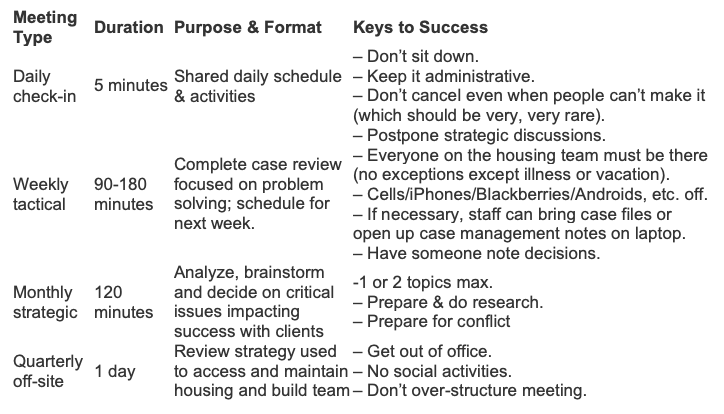
Getting organizations oriented to this type of meeting structure can take some arm-twisting, cajoling and reassurance that it is worth people’s time. However, I have yet to meet a successful housing program that instilled this approach that didn’t see the dividends of it once they got it into place.
All of the meeting types are important, but if I had to put all my eggs in one basket it would be the weekly tactical meeting. This is the meeting where I want each case manager to briefly (90 seconds or less) review each household that they are working with, the client’s current acuity measurement compared to past acuity measurement (read more about one approach to establishing acuity), the case plan priorities for the client, the three objectives for the next home visit with the client and when the visit will be occurring. Each case manager is allowed two holds per meeting for a more extensive discussion with their peers and joint problem solving on particular cases. It is the Team Leader’s job to chair the meeting and keep the meeting moving. I also suggest starting at either end of the alphabet in alternate weeks.
With someone to record all that is discussed on a white board, shared file or the like, it is possible to see at a glance who all is being served by the program, the general state of stability of the case load and the movement towards greater independence with each client. It creates a structure of increased accountability. What case managers tend to love about it is that it gets them out of a crisis mode with their clients and into a deliberate and planned framework…they know how they will spend their day, who they will see and what will be happening during those interactions. This is really important because these types of housing programs are not crisis services, they are case management services.
An example recording of a few client names (names are fictitious) may look like this in the weekly tactical meeting:

The last piece I’ll cover in the Team Structure and Functions is the type of person who is a good candidate to deliver excellent service given this is professional work (as opposed to charity or volunteer driven work). What I have always wanted on the teams I have created or coached are people who can successfully answer these five questions for themselves and to my satisfaction:
Why am I here? (I want to hear that people share the belief in the mission at hand.)
Where am I going? (I want to hear that people are committed and share a vision of ending homelessness – even if it is just one person, one family at a time.)
How am I doing? (I want to hear that people reflect on their practice and strive to get better; that they want feedback and coaching.)
What’s in it for me? (I want to know what their motivation is for doing the work and how it enriches them. In most instances it isn’t going to be money. What I am really hoping it is NOT is filling time until the next opportunity comes along.)
Where do I go for help? (I want people who will trust their team members and team leader to assist them in case planning, who are dedicated to the team unit as a whole. People who are passionate about learning and challenging themselves are also quite welcome so long as it relates to the mission.)
There is no doubt that the structure of the team is one of the key elements of housing program success. In smaller communities I have seen a shared Team Leader across agencies and/or housing case managers from different organizations collaborating together to form one cohesive team. In larger agencies and communities I have seen multiple housing teams within the same agency with multiple Team Leaders and discrete teams. The key to success is to stay true to the structure to best meet the needs of the people you want to serve from a quality perspective.
[serialposts]
Iain De Jong has been involved in the development of his own housing teams and has helped organizations throughout the world establish their own successful housing teams. The structure presented here is no accident. It comes from years of practical experience, evaluation and peer review to land on the right structure for successful housing programs. If you have any questions or want help setting up your housing team to maximize success, drop him a line at idejong@orgcode.com
Service Orientation
[serialposts]
In this multi-part blog series we are examining the essential elements of successful housing programs that focus on ending homelessness. We pick up here in Part 2 looking at the Service Orientation that is necessary.
PART TWO: Service Orientation
The secret to a successful housing program? Meet people where they are at in their life journey. Don’t set up barriers or unattainable expectations. Accept the decisions that people have made in their life and how they became homeless at face value, help them achieve housing, and then provide the supports necessary to help them achieve long-term residential stability.
In case you missed the subtlety – house people, then support them. If you put together an elaborate service plan or case plan prior to helping someone get housing you are doing it “bass ackwards”.
House people then support them. The evidence is clear that people achieve better long-term housing outcomes and achieve a more positive quality of life when this is the sequence of evidence. While it remains popular for there to be life skills training, budgeting classes, skills upgrading, addiction treatment, etc prior to helping people achieve housing, the evidence would suggest that this is unwarranted and actually results in poorer housing outcomes long term.
We shouldn’t have different standards of behavior for people who access human services compared to others in society generally. For example, sobriety is not a precondition for successful long-term housing. Statistically, most people who are alcoholics or who use other substances are housed, not homeless. Any housing program that requires people demonstrate sobriety for any length of time prior to gaining access to housing is lengthening a person’s homeless experience for a reason not supported by fact. Furthermore, any program that drops support services because someone has started using again is, in my opinion, doing a better job of creating homelessness than ending it.
We need to wrap our heads around what harm reduction is and why it is important for the population that we are working with. We are trying to focus on ways of reducing harm to the individual and community/society at large. We are looking at things like substance use and sex work from a community health and public health perspective. Harm Reduction is not an approach that demands the client achieve sobriety over time. While it can be effectively blended with approaches that decrease involvement in harmful activities, first and foremost a harm reduction approach tries to decreases risks associated with use. For example, using with friends instead of alone or with strangers; use of condoms; use of clean needles and safer crack use kits; drinking palatable alcohol instead of non-palatable alcohol. Some clients may have a goal of abstinence, but this is not a requirement. A harm reduction approach is pragmatic. Not only does it increase the health and stability of the client, it also has public health benefits, decreases policing costs, and also decreases emergency room, ambulance and hospital costs.
As someone who lives with a mental illness (depression) I know I can have strong opinions about how many organizations view and support persons with compromised mental wellness. In the context of creating and maintaining successful housing programs I would urge you to understand, embrace, support and practice recovery-oriented practices with individuals that have experienced compromised mental wellness. I would suggest that everyone learn about the practices and work of the likes of Mary Ellen Copeland and Patricia Deegan. I want people to know how to support individuals who have experienced mental illness in having a hopeful orientation towards the future, with an increased understanding of symptoms and triggers, with thoughtful crisis planning and awareness of resources and approaches that can be used. I want people to know how much survivors of psychiatric services have come to emphatically embrace these practices and experience better housing and quality of life outcomes as a result. I want people who have experience mental illness to feel empowered to have a voice in their care and supports.
For housing programs to be successful, punitive approaches when people relapse – whether that is in their substance use, medication management, housing stability, etc. – should be replaced with approaches that try to focus on what lessons can be learned and how to achieve stability and housing success in the future. People will relapse and it is natural. Sure, we would love to prevent it as much as possible and support people as necessary to try and mitigate it from occurring. But relapse will happen.
Related to this is a relapse into homelessness. Not everyone supported by a program is going to remain housed despite all of the efforts a housing team puts into it. But let’s not rip away their supports or refer to them as a failure or make them go to the bottom of the waiting list if they lose their housing. NO! Let’s re-house them, learn what we can do better and focus on how greater sustainability can be achieved the next go around.
We also need to move away from program models that are coercive if we want to have a successful housing program. Clients should never be tricked or forced to do anything that they don’t want to do. I urge people to be fully transparent on what the housing program and supports are that we are offering and let people choose if that is right for them.
A critical component for a successful housing program is client choice. This starts with empowering the people we work with to choose where they want to live. Some people may want permanent supportive housing while others may want scattered site housing with supports. Some people may want an efficiency or bachelor unit while others will want a one-bedroom. Some people may want housing close to the downtown while others want to be as far away from downtown as possible. Housing programs need to stop thinking that they place people into housing and start thinking that they provide meaningful housing choices for people. We don’t know what is best for people. What we should know is which options we can present that are affordable, actionable (reason to believe the landlord will rent to us) and appropriate (e.g., there are no legal restrictions on where they can live; it isn’t a four storey walk up and the person uses a mobility assistance device). Then we need to respect the housing choice that the client makes and support them in that housing.
We also need program participants to choose the type, duration, frequency and intensity of the service supports that they receive. If we do this in the right way we can remain truly client-centered and support people through the stages of change. This doesn’t mean we are client-directed. It also doesn’t mean that we are system-centered. It means that we are going to take the necessary steps to ensure that our service delivery and organization remain centered on opportunity for growth and positive change.
We need to know under what circumstances it is prudent to create intentional conversations, practice respectful persistence and engage assertively with the people we work with. We are agents of change; navigators of resources. We don’t heal people. We don’t fix people. We aren’t directly responsible for the decisions that people make in their lives. But we should do the best we can to provide access to information and opportunities that will allow people to engage in activities that will provide the greatest likelihood of quality of life improvements.
We need to think of our work as professional work. Damien Cox, a writer for the Toronto Star, said of my beloved Maple Leafs (and I am paraphrasing) “Stupid and nice is no way to run a hockey team.” I know and appreciate that people get involved in delivering services to homeless people for a wide range of reasons. But they need to know the limits of what they can do versus what experts need to do. I think of, for example, the Sisters of St. Joseph and their involvement in health care and development and administration of hospitals. The Sisters knew the difference between their role and the role of trained medical professionals. They didn’t try to do things that they were neither qualified nor trained to do. They knew that doing so would hurt or even kill more people than it helped.
Given the populations that we are serving, it is necessary to orient program delivery such that it happens in the community. Supports cannot meaningfully be delivered by text message or email or phone call. We need to go meet them in their housing. We need to see the condition of their housing. We need to see their adjustment and skill implementation first hand. We need to respect and support people’s natural settings. We can’t do this in an office. We need to go to the people.
As support functions go, I find it is best when organizations embrace their role as teacher, model and resource specialist. I strongly suggest staff make themselves available to accompany people to appointments. We need to be willing to do a load of dishes or load of laundry with people to teach them the skills. We should demonstrate the likes of budgeting by taking people grocery shopping. We need to be prepared to roll up our sleeves and clean toilets and showers and the like until people have the skills to do it themselves. We need to know whom else within the community we may recommend that the client connect to and for what purpose.
Deficit-based approaches to working with people are not as successful as strength-based approaches. I appreciate that sometimes finding the strengths beneath a rough exterior and years of hard living can present some challenges. Truth is, a lot of the people that we work with may not have traditional strengths. We need to be creative in how we work with and look at the life experience of people. The will to survive after years of living under a bridge may be seen as a strength. Considerable stubbornness may actually be viewed as a strength. Managing one’s basic needs while dealing with active psychosis may be seen as a strength. And I could go on.
Our job when we work with people to support them in housing is to orient our approach such that we enhance dignity and empowerment by making the people we serve the center of all planning activities and goal setting. I suggest transparency and a small wins approach, with the patience to accept that people will change their minds. I want the people we serve to think about the obstacles that may come up and how they will tackle those challenges before they ever happen.
For many years some of the people with the most complex needs have been subject to compliance based programs. This means that they have to do things like demonstrate sobriety for a fixed length of time, take medications, agree to see a psychiatrist, agree to take anger management courses, etc. in exchange for having a roof over their head. Anytime compliance faltered, the individual was subject to a “three strikes and you’re out” or “contracting” process or else asked to leave immediately. Too often this meant a return to homelessness. Evidence suggests that compliance-based service delivery does not achieve impressive housing outcomes, especially in the longer-term.
We need to help the clients we serve understand what our role is and the length of time we are available in their life for. I want clients to achieve greater independence over time. This helps inform the approach used to case planning and supports. It also makes me critically aware at all times that establishing a dependent relationship is not going to be helpful or sustainable longer term. I suggest as many connections as possible to mainstream services with a strong focus on community integration.
There are only six types of homeless people: Someone’s mother. Someone’s father. Someone’s sister. Someone’s brother. Someone’s daughter. Someone’s son. I really love when I see compassionate service providers who never lose sight of the humanity of our work. It is these organizations that exemplify the non-judgmental attitude that I think we need…the same sort of acceptance without criticism that I would love to receive should I ever find myself homeless.
[SERIALPOSTS]
Iain provides extensive workshop training and keynote addresses on changing ideological approaches to truly focus on ending homelessness in a way that accepts people where they are at. Comfortable with his many own imperfections, Iain has found that the focus on the right service orientation not only improves housing outcomes, it also shakes up some of the underpinnings of homeless service delivery systems by encouraging critical analysis of why some programs operate the way that they do.